1. What Is Conformal Cooling Technology?
Conformal cooling technology is a manufacturing approach that uses 3D-printed metal mold components containing cooling channels that conform to — follow the exact 3D shape of — the mold cavity surface. The channels run parallel to the part surface at a constant distance of typically 2–5mm, maintaining uniform heat extraction across the entire part geometry.
The contrast with conventional cooling is fundamental:
- Conventional cooling: Straight channels drilled from the mold perimeter. The channel path is dictated by drill bit geometry, not part shape. Result: cooling uniformity limited by how close straight lines can approach a curved surface.
- Conformal cooling: Channel path designed in simulation software to follow part contour. The channel route is limited only by LPBF minimum feature size (~0.4mm) and structural integrity requirements. Result: ±2–3°C temperature uniformity vs. ±15–40°C for conventional.
2. The Physics: Why It Works
Injection molding cooling time follows the Dubois formula for cooling time to ejection temperature:
tcool = (s² / π² · α) × ln[(4/π) × (Tm - Tw) / (Te - Tw)]
Where: s = wall thickness, α = thermal diffusivity of polymer, Tm = melt temperature, Tw = mold wall temperature, Te = ejection temperature
The key insight: Tw (mold wall temperature) appears in the logarithm. Small changes in mold wall temperature — particularly reducing hot spots — have disproportionately large effects on cooling time.
Heat Transfer Chain
Heat flows from the plastic part to the coolant via three resistances in series:
- Conduction through plastic — fixed by part geometry and polymer thermal properties
- Conduction through mold steel — reduced by minimizing channel-to-surface distance
- Convection to coolant — governed by Nusselt number, which improves dramatically with turbulent flow (Re > 10,000)
Conformal cooling improves resistance #2 (shorter path, more uniform path) and enables optimization of #3 (channel diameter can be sized for turbulent flow at practical pump pressures). Conventional drilling provides limited improvement to #2 and no improvement to uniformity.
3. Manufacturing Technology: LPBF Dominates
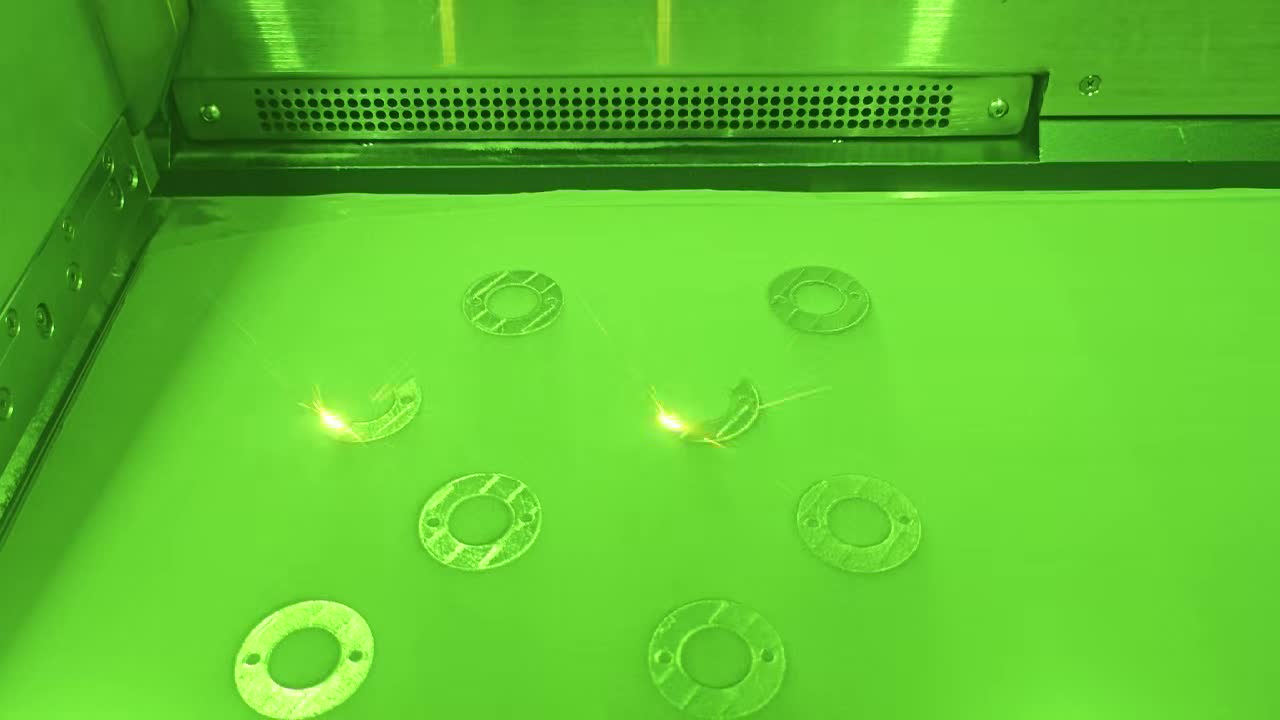
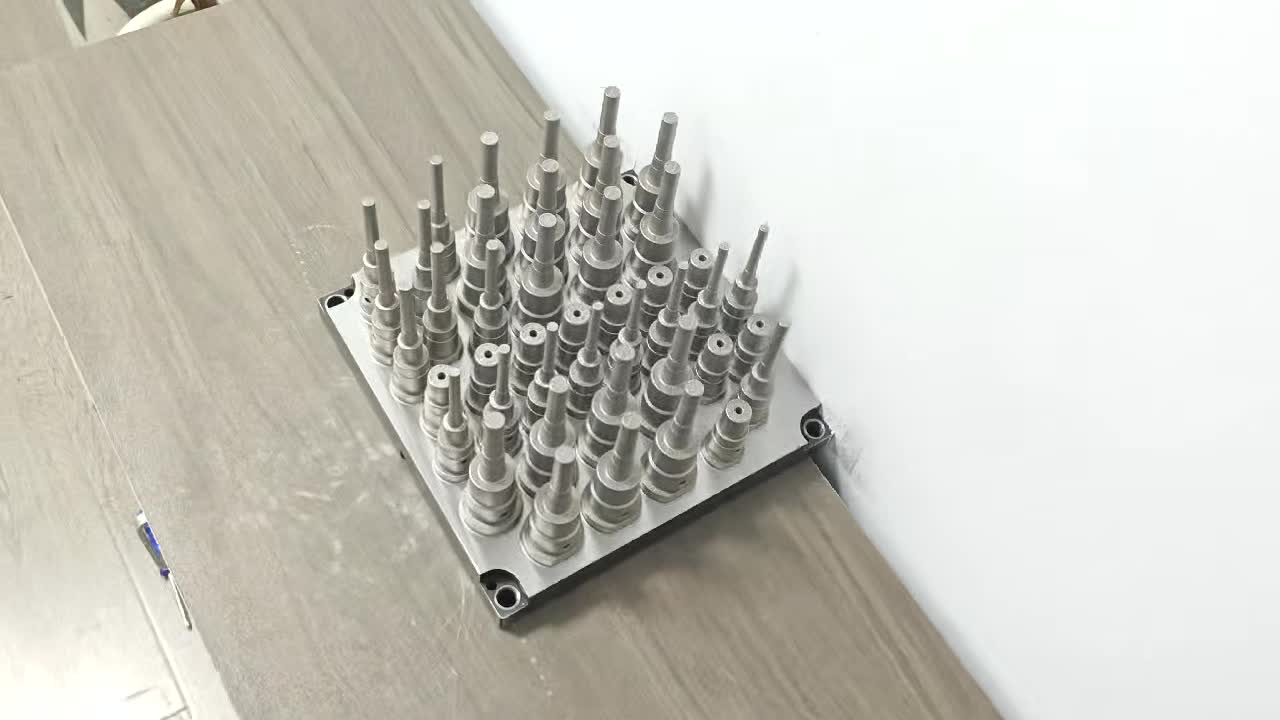
The enabling technology for conformal cooling is Laser Powder Bed Fusion (LPBF), commercially known as SLM (Selective Laser Melting), DMLS (Direct Metal Laser Sintering), or LaserCUSING depending on equipment manufacturer.
How LPBF Works
- Metal powder (15–45μm particle size) is spread in thin layers (20–60μm) across a build platform
- A high-power laser (200–1,000W) selectively melts and fuses powder according to the slice data from the 3D model
- The platform indexes down one layer, fresh powder is spread, and the process repeats
- After printing, the part is removed from unmelted powder, stress-relieved at 600–700°C, and CNC-finished to final dimensions
Why LPBF Is Uniquely Suited to Conformal Cooling
- Arbitrary 3D geometry — channels can follow any curve, spiral, or lattice path
- Self-supporting to 45° — channels angled >45° from horizontal don't need support structures inside
- Feature resolution — minimum channel diameter ~3mm reliably, 2mm achievable; sufficient for all practical cooling circuits
- Material density — LPBF achieves 99.5–99.9% density with HIP, providing full mechanical integrity under injection pressure
- Direct printing — no tooling, no intermediate steps; design change = rebuild file → reprint
LPBF vs. Other AM Processes for Conformal Cooling
| Process | Market Share (cooling inserts) | Key Advantage | Key Limitation |
|---|---|---|---|
| LPBF / SLM / DMLS | ~85% | Best resolution, widest material range, production-proven | Residual stress requires HIP; surface finish Ra 8–16μm requires CNC |
| Binder Jetting (Metal) | ~8% | Faster builds, lower per-unit cost at scale | Lower density without HIP, limited to simpler channels, less material choice |
| DED / LENS | ~4% | Excellent for repair and hybrid manufacturing | Poor resolution for small channels, limited for new inserts |
| EBM (Electron Beam) | ~3% | Excellent for titanium; near-zero residual stress | Limited material options (mainly Ti), coarser resolution |
4. Channel Geometry Evolution
Conformal cooling channel geometry has evolved through three generations since commercial adoption began:
Generation 1 (2005–2015): Conformal Single-Path
The first commercial conformal channels were simply conventional-shaped channels bent to follow the mold surface — a single spiral or serpentine path, hand-designed in CAD. Significant improvement over straight drilling, but limited by flow balance problems (all coolant follows one path) and flow circuit dead zones.
Temperature uniformity achieved: ±8–15°C (vs. ±20–40°C conventional).
Generation 2 (2015–2022): Zone-Optimized Multi-Circuit
With better simulation software (Moldflow 3D FEM analysis, Moldex3D eDesign), engineers could identify hot zones and design targeted cooling for each zone independently. Multi-circuit designs with separate inlet/outlet connections for cavity and core, plus specialized channels for ribs and bosses.
Temperature uniformity achieved: ±3–8°C. Cycle time reduction: 30–50%.
Generation 3 (2022–Present): TPMS and Topology-Optimized
Triply Periodic Minimal Surface (TPMS) geometries — particularly the gyroid and Schwartz Diamond lattice structures — offer theoretically optimal surface-area-to-volume ratios for heat transfer. Generated using nTop or similar topology optimization software.
TPMS channels offer ~30% more surface area per unit volume vs. circular channels of equivalent hydraulic diameter. Combined with computational fluid dynamics optimization, Gen 3 designs achieve ±1–3°C temperature uniformity.
Current limitation: TPMS channels are more expensive to design and manufacture, and require CFD validation (ANSYS Fluent) to confirm flow distribution. Best reserved for high-value, high-volume molds.
5. Material Technology
Material selection for LPBF conformal cooling inserts involves balancing thermal conductivity, hardness, fatigue life, and printability:
| Material | Hardness (as-built) | After Heat Treatment | Thermal Conductivity | Use Case |
|---|---|---|---|---|
| 420 Stainless Steel | 25–30 HRC | 48–52 HRC (HT 1020°C) | 24–28 W/m·K | Standard injection molds. Most widely used, lowest cost. |
| 18Ni300 Maraging Steel | 33–38 HRC | 52–56 HRC (aging 480°C) | 25–30 W/m·K | High-cycle, high-pressure molds. Superior fatigue life. |
| H13 Tool Steel | 42–46 HRC | 50–54 HRC | 28–32 W/m·K | Die casting. Excellent hot hardness retention. |
| CuCrZr Copper Alloy | 75–85 HRB | 85–95 HRB (aging) | 300–320 W/m·K | Maximum heat extraction. Soft — limited to lightly loaded areas. |
| Inconel 625 / 718 | 20–25 HRC | 40–45 HRC | 10–15 W/m·K | High-temperature applications, corrosive resins. Rarely used for cooling. |
Emerging Material Technology: Functionally Graded Inserts
A research-stage technology (not yet in production at scale): printing a mold insert with gradually changing material composition — hard steel at the surface, high-conductivity copper alloy toward the channels — in a single LPBF build. Achieved in laboratory settings using dual-powder LPBF systems. Commercial availability expected by 2027–2028.
6. Simulation & Design Software
The conformal cooling software stack in 2026 has matured significantly:
| Layer | Leading Tools | Role |
|---|---|---|
| Channel geometry generation | nTop, Autodesk Fusion 360 (Gen), Siemens NX Topology | Create optimal channel paths from part geometry |
| Full cycle simulation | Moldflow Insight, Moldex3D R&D, Sigmasoft | Predict cycle time, temperature uniformity, warpage |
| Channel hydraulics | ANSYS Fluent, SolidWorks Flow Simulation | Verify flow distribution, Reynolds number, pressure drop |
| Structural integrity | ANSYS Mechanical, Abaqus | Fatigue life under cyclic thermal/pressure loading |
| LPBF build preparation | Materialise Magics, 3D Systems 3DXpert | Support generation, slice, machine setup |
For a full discussion of software selection, see our guide: Conformal Cooling Design Software Compared.
7. Market Adoption in 2026
Conformal cooling has transitioned from early adopter to early majority in most high-value injection molding segments. Key adoption metrics as of 2026:
~25% of Precision Mold Shops
The automotive sector leads adoption. Most Tier 1 OEM suppliers now require conformal cooling capability evaluation for new mold programs. German/Japanese OEMs are primary drivers of adoption specification.
~18% of Precision Medical Mold Shops
Medical adoption is growing fast, driven by dimensional consistency requirements and cycle time pressure from CDMO and contract manufacturing customers. Full material traceability now standard expectation.
~8% of Mid/High Volume Mold Shops
Adoption in consumer/packaging is accelerating as insert costs have fallen 35–45% since 2020. Multi-cavity mold economics are compelling — insert cost is amortized across high part volumes.
~8–15% Adoption (Precision Molds)
Globally, an estimated 8–15% of precision injection mold shops with cycle times >20 seconds have deployed conformal cooling on at least one production mold. The biggest barrier remains upfront cost and design expertise.
Geographic Adoption Leaders
| Region | Adoption Level | Primary Driver |
|---|---|---|
| Germany / Austria / Switzerland (DACH) | High (25–35%) | Precision engineering culture, strong LPBF equipment base (EOS, Trumpf, SLM Solutions all German) |
| USA | Medium-High (15–25%) | Automotive (Detroit region), medical devices, aerospace composite tooling |
| Japan / South Korea | Medium (10–20%) | Electronics mold precision requirements, automotive Tier 1 supply chain |
| China | Fast Growing (8–15%) | Saiguang 3D and other LPBF service bureaus driving adoption with competitive pricing |
| India | Early Adopter (3–8%) | Automotive hub (Pune, Chennai), growing awareness of technology |
| Southeast Asia | Emerging (2–5%) | Thailand automotive (Honda, Toyota), Vietnam electronics |
8. Cost Technology Trajectory
The cost of conformal cooling inserts has fallen substantially since 2015, driven by LPBF equipment cost reduction, improved build efficiency, and Chinese service bureau competition:
| Year | Typical Insert Cost (US, 60×60×40mm) | Key Driver |
|---|---|---|
| 2015 | $8,000–12,000 | Early LPBF machines, limited service bureaus, high powder cost |
| 2018 | $5,000–8,000 | EOS M290, Concept Laser mainstream, China service bureaus entering |
| 2021 | $3,000–5,000 | Commodity LPBF systems, Chinese competition, improved build rates |
| 2024 | $1,800–3,500 | High-speed LPBF (SLM280 2.0, Nikon/SLM, FormAlloy), China pricing leadership |
| 2026 | $1,200–2,800 | Current pricing from Chinese service bureaus; Western suppliers $3,000–6,000 |
Price decline rate: approximately 12–18% per year over the past decade, following a learning curve similar to CNC machining in the 1980s. This trajectory is expected to continue through 2030 as LPBF becomes more commodity-like.
9. Application Verticals
Conformal cooling technology is most valuable where:
- Part geometry is complex (non-planar, deep cores, ribs)
- Cycle time is long (cooling is limiting step)
- Production volumes are high (ROI amortization is fast)
- Part quality requirements are tight (warpage, dimensional tolerance)
Automotive Interior Trim
Dashboard components, door panels, A/B/C-pillar trims, and HVAC housings. Complex geometry, long cycles (30–90s), high volumes, critical warpage spec. 35–50% cycle reduction typical.
EV Battery Housings
Electric vehicle battery components — covers, connectors, thermal management components — are a rapidly growing conformal cooling application with demanding dimensional requirements.
Medical Device Components
Diagnostic housings, drug delivery devices, surgical instrument handles. The combination of dimensional precision and cycle time efficiency drives adoption at premium mold price points.
Multi-Cavity Packaging
Bottle caps, closures, containers, and thin-wall packaging. Even modest cycle time savings (8–15%) deliver compelling ROI across 8–64 cavity molds running millions of shots per year.
Optical & Electronics
Lens housings, connectors, and semiconductor device packaging where temperature uniformity is critical for dimensional stability and optical performance (sink marks, birefringence).
Die Casting
H13 conformal cooling for aluminum, zinc, and magnesium die casting. Different design rules (higher temperature, pressure) but strong ROI potential for high-volume automotive die casting.
10. What's Next: 2026–2030
Several technology trends will shape conformal cooling over the next four years:
AI-Driven Channel Design
Machine learning models trained on thousands of simulated conformal cooling designs are beginning to automate channel path generation. Given a part geometry and production requirements, AI tools can generate optimized channel layouts in minutes vs. hours for experienced engineers. Currently in commercial beta at Autodesk and several LPBF vendors.
Hybrid Printing + Machining Centers
Combined LPBF + CNC machines (DMG Mori LASERTEC series, Optomec, Trumpf TruLaser Cell) allow printing internal channel structures and machining critical surfaces in one setup, eliminating re-fixturing and improving dimensional accuracy. Reduces lead time for finished inserts from 7–10 days to 3–5 days for appropriately sized parts.
Real-Time Thermal Monitoring
Integration of thermocouples (and future fiber optic temperature sensors) into the mold adjacent to conformal channels, feeding real-time data to adaptive process control systems. Automatically adjusts coolant flow, temperature, and cycle time parameters to maintain optimal mold temperature despite shot-to-shot variation and resin lot differences.
Further Cost Reduction
LPBF equipment costs continue to fall. The entry-level industrial LPBF machine that cost $500,000 in 2018 can be purchased for $180,000–$250,000 in 2026. By 2028–2030, sub-$100,000 industrial-grade LPBF systems are expected from Chinese manufacturers (BLT, Farsoon, Bambu Lab Metal). This will further drive service bureau price competition and bring conformal cooling within reach of smaller mold shops.
Ready to Implement Conformal Cooling Technology?
Send us your mold insert drawing. We design the conformal channel path, simulate the thermal performance, and manufacture the insert — 10–14 day delivery worldwide.
View Our Conformal Cooling Service → WhatsApp for Quick Quote