Automotive injection molding is the single largest application segment for conformal cooling inserts. The reason is straightforward: automotive programs combine high annual volumes, tight dimensional tolerances, and complex geometries with deep ribs and variable wall thickness. These three factors together create the conditions where conformal cooling delivers its largest financial and quality returns.
This guide covers the three main categories of automotive injection-molded parts where conformal cooling has the greatest impact: interior trim, electrical connectors, and under-hood structural components. Each section includes the specific cooling challenges for that part category, the mechanism by which conformal cooling solves them, and the performance data you can expect. Section 7 presents three real case studies with full before/after metrics.
1. Why Automotive Is the Biggest Market for Conformal Cooling
The automotive industry accounts for an estimated 35–40% of all conformal cooling insert deployments worldwide. This dominance is driven by five structural characteristics of automotive injection molding programs that amplify conformal cooling ROI beyond what other industries can match:
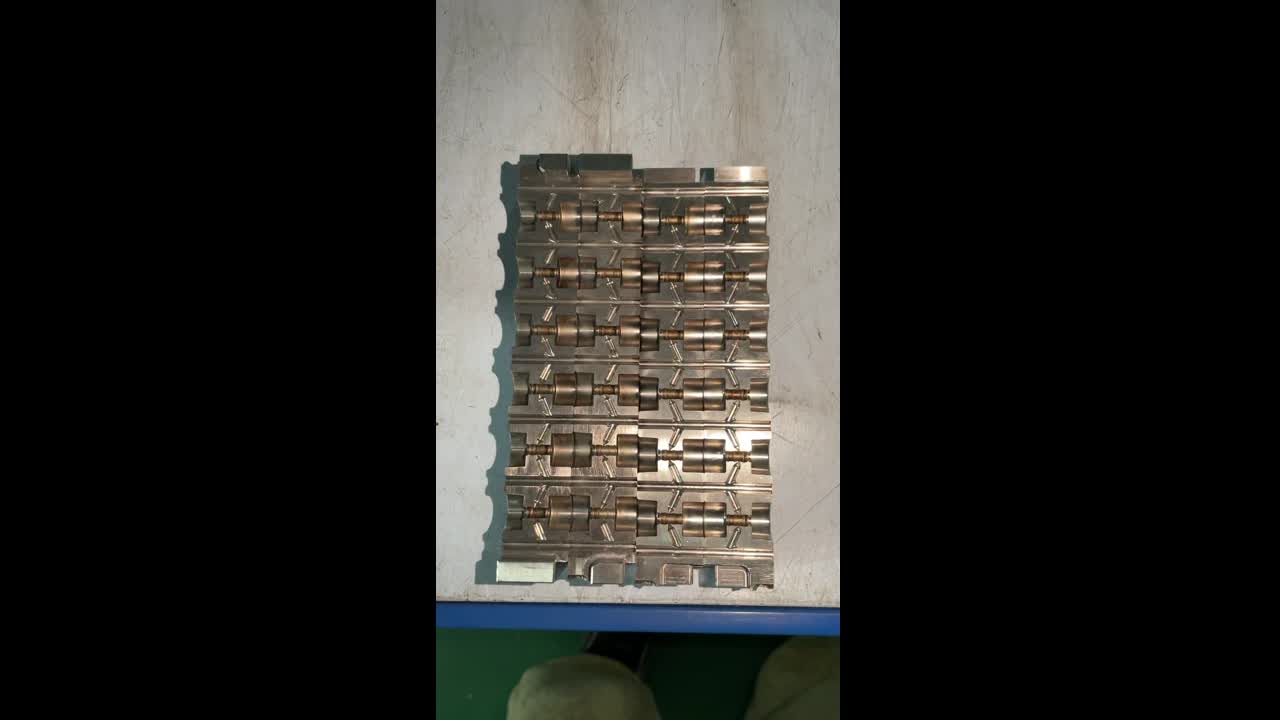
- Volume: A single automotive part program typically runs 500,000 to 5,000,000 shots per year per tool. At these volumes, even a 1% cycle time improvement translates to tens of thousands of dollars in annual throughput savings.
- Tolerance requirements: Automotive OEMs enforce dimensional tolerances of +/-0.1 mm to +/-0.3 mm on most injection-molded parts, with even tighter requirements on functional surfaces. Conventional cooling circuits cannot hold uniform mold surface temperature across complex geometries, creating warpage that drives scrap rates above 5%.
- Part complexity: Automotive interior panels, structural brackets, and connectors feature deep ribs, snap-fit features, and variable wall thickness from 1.2 mm to 4.5 mm. Conventional straight-drilled cooling circuits cannot follow these geometries. Conformal channels can.
- Machine rates: Automotive injection molding operations in the US, Germany, and Japan typically run at $80–$120/hr fully loaded machine rates. Higher machine rates mean every second saved per cycle is worth more money.
- Quality systems pressure: IATF 16949 mandates documented process capability studies (Cpk/Ppk) and systematic root cause analysis for dimensional non-conformances. Conformal cooling improves Cpk values by 30–60% on critical dimensions by reducing thermal-driven variation — directly addressing the most common root cause of dimensional non-conformance in injection molding.
At $90/hr machine rate and 1 million shots/year, every 1% of cycle time reduction is worth approximately $5,400/year in throughput alone. A 28% cycle reduction — typical for automotive interior parts — saves $151,200/year on a single tool. The insert cost of $2,500–$3,500 pays back in less than one week.
2. Interior Trim Parts — Warpage Reduction and Cycle Time Savings
Interior trim parts — door panels, instrument panel carriers, A/B/C pillar trims, center console housings, and glove box doors — are the highest-value application for conformal cooling in the automotive sector. These parts share several characteristics that make them especially responsive to conformal cooling:
The Problem: Uneven Cooling Creates Warpage
Interior trim parts are typically molded from ABS, PC/ABS, or PP with wall thickness varying from 1.5 mm (thin flanges and snap features) to 4.0 mm (mounting bosses and rib intersections). Conventional straight-drilled cooling circuits are limited to straight lines through the mold steel, which means they cannot follow the contour of complex surfaces. The result is predictable and well-documented:
- Hot spots at rib-to-wall intersections: Where thick rib bases meet thinner wall sections, the extra mass takes longer to cool. The difference in solidification time creates differential shrinkage that warps the part.
- Cold spots at channel-adjacent areas: Areas directly above a conventional cooling line cool too quickly, creating a temperature gradient of 15–30 degrees C between the hottest and coldest points on the mold surface.
- Extended cooling time to compensate: To prevent warpage, molders increase cooling time by 20–40% beyond what the thinnest wall section requires. This longer cycle reduces throughput without fully solving the warpage problem.
The Solution: Conformal Channels Follow the Part Surface
Conformal cooling channels are 3D-printed directly into the mold insert using selective laser melting (SLM). Because they are not constrained to straight-line paths, they can follow the contour of the part surface at a uniform distance of 4–8 mm, maintaining consistent heat extraction across the entire mold face. The results on interior trim parts are consistent:
| Metric | Conventional Cooling | Conformal Cooling | Improvement |
|---|---|---|---|
| Mold surface temperature variation | +/-15 to +/-28 °C | +/-2 to +/-5 °C | 80–85% reduction |
| Cooling time (typical door panel) | 32–45 seconds | 20–30 seconds | 25–35% reduction |
| Warpage (mm deviation from CAD) | 0.8–2.5 mm | 0.1–0.4 mm | 75–90% reduction |
| Scrap rate (warpage-driven) | 5–8% | 0.5–1.5% | 4–7 point reduction |
| Surface gloss uniformity (Class A) | Variable — 20–40% cosmetic rejects | Uniform — below 2% cosmetic rejects | 90% fewer cosmetic rejects |
For parts with Class-A surface requirements — such as visible door panel faces and instrument panel trims — conformal cooling eliminates the gloss variation and sink marks caused by uneven cooling. This is particularly significant because cosmetic rejects are typically not recyclable into the same color lot, making each reject a full material write-off.
3. Electrical Connectors — Precision Cooling for Tight Tolerances
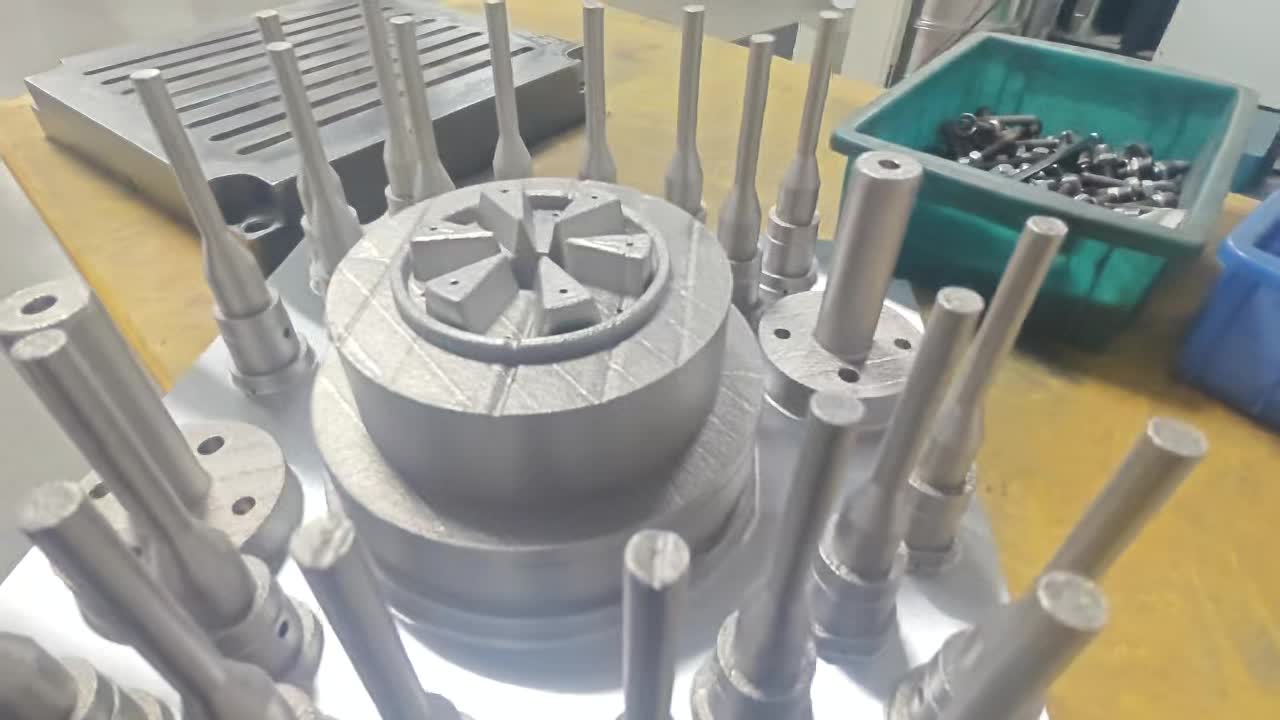
Automotive electrical connectors are small, high-precision parts molded from PA66, PBT, or LCP in multi-cavity tools (16 to 64 cavities). They present a distinct cooling challenge: extremely tight tolerances on pin-to-pin spacing (+/-0.05 mm typical) combined with thin walls (0.4–1.2 mm) and deep, narrow cavities that are physically inaccessible to conventional drilled cooling lines.
Why Connectors Need Conformal Cooling
In a 32-cavity connector mold, conventional cooling creates cavity-to-cavity temperature variation of 8–15 degrees C. This variation is caused by the distance each cavity sits from the nearest cooling line — outer cavities are closer to the mold edge and cool differently from inner cavities. The consequences are measurable:
- Pin spacing variation across cavities: Outer cavities shrink differently from inner cavities, producing pin-to-pin spacing variation that exceeds the +/-0.05 mm tolerance band. Sorting by cavity becomes necessary, adding labor cost.
- Flash on high-temperature cavities: Hotter cavities run at lower melt viscosity, generating flash at parting lines. Flash on connectors causes functional failures in assembly.
- Extended cooling time for worst-case cavity: The cycle must be set for the slowest-cooling cavity, penalising all cavities. In a 32-cavity tool, the best cavity may need 8 seconds of cooling while the worst needs 14 seconds — and the cycle runs at 14.
Conformal Cooling Equalises All Cavities
Conformal cooling circuits designed individually for each cavity position ensure that every cavity reaches the same ejection temperature at the same time. The practical impact on connector production is significant:
Cavity-to-cavity temperature variation: Reduced from +/-12 degrees C to +/-2 degrees C.
Cycle time: Reduced by 30–40% because the cooling time is now set by the optimal cooling rate, not the worst-case cavity.
Pin spacing Cpk: Improved from 1.1–1.3 (marginal) to 1.8–2.2 (excellent), eliminating the need for cavity sorting.
Flash reject rate: Reduced from 2–4% to below 0.3% by eliminating hot-cavity viscosity variation.
Tool life: Extended by 20–30% because uniform thermal cycling reduces thermal fatigue cracking on thin core pins.
For high-volume connector programs running 2M+ shots per year, the combination of 35% cycle time reduction and elimination of cavity sorting labor makes conformal cooling inserts the highest-ROI single improvement available. The insert cost per cavity on a 32-cavity tool is typically $80–$120 — paid back within the first 1–3 days of production.
4. Under-Hood Components — High-Temp Materials Requiring Uniform Cooling
Under-hood injection molded parts — engine covers, intake manifold components, structural brackets, sensor housings, and ECU enclosures — are molded from high-performance engineering resins that demand mold temperatures far above what commodity resins require. This elevated mold temperature creates a fundamentally different cooling challenge.
The High-Temperature Material Challenge
| Material | Typical Mold Temperature | Processing Window | Cooling Sensitivity |
|---|---|---|---|
| PA66-GF30 (30% glass-filled nylon) | 80–100 °C | Narrow — crystallinity depends on cooling rate | High — non-uniform cooling causes warpage and inconsistent mechanical properties |
| PA6-GF50 (50% glass-filled nylon) | 80–110 °C | Very narrow — fiber orientation highly sensitive to flow/cooling balance | Very high — differential cooling alters fiber orientation and creates weld line weakness |
| PPS (Polyphenylene Sulfide) | 130–150 °C | Extremely narrow — requires controlled crystallisation | Critical — cooling rate directly controls crystallinity, which controls chemical resistance and strength |
| PPA (Polyphthalamide) | 120–140 °C | Narrow — similar to PPS | High — used in structural connectors where dimensional stability under thermal cycling is critical |
At mold temperatures of 80–150 degrees C, the temperature differential between the coolant (typically running at 60–120 degrees C) and the mold surface is much smaller than in commodity molding. This smaller differential means that any geometric variation in coolant-to-surface distance has a proportionally larger effect on local cooling rate. Conventional straight-drilled circuits that produce +/-8 degrees C variation at a 40 degrees C mold temperature will produce +/-15 to +/-25 degrees C variation at a 120 degrees C mold temperature — because the system has less thermal headroom to absorb geometric inefficiencies.
How Conformal Cooling Solves Under-Hood Challenges
Conformal channels maintain a consistent 5–8 mm distance from the mold surface regardless of part geometry, delivering temperature uniformity within +/-3 degrees C even at mold temperatures above 120 degrees C. The benefits for under-hood parts are specific and measurable:
- Controlled crystallinity in PA66 and PPS: Uniform cooling rate across the part ensures consistent crystallinity development, which directly controls tensile strength, chemical resistance, and dimensional stability under thermal cycling. For engine bay components exposed to 150 degrees C continuous operating temperature, this is a functional requirement, not just a quality improvement.
- Reduced fiber orientation defects in GF-filled resins: Glass fibers orient preferentially along flow direction during filling, and the final fiber orientation is locked in during cooling. Non-uniform cooling creates zones where fibers reorient during solidification, producing locally weak areas. Conformal cooling locks fiber orientation more uniformly, improving part-to-part consistency in tensile and impact strength by 12–20%.
- Cycle time reduction of 20–30%: Under-hood parts typically run longer cycles than interior trim (45–75 seconds) because extended cooling is needed to ensure dimensional stability at elevated mold temperatures. Conformal cooling achieves the same dimensional stability in less time because every point on the mold surface reaches ejection temperature simultaneously.
- Elimination of post-mold annealing: Some under-hood parts require post-mold heat treatment (annealing) to relieve residual stresses caused by non-uniform cooling. Conformal cooling reduces residual stress to the point where annealing is often eliminated entirely — saving $0.15–$0.40/part in secondary operations.
For PA66-GF30 structural brackets running at 90 degrees C mold temperature: conformal cooling reduced mold surface temperature variation from +/-18 degrees C to +/-3 degrees C, cut cycle time from 58 seconds to 42 seconds (27.6% reduction), and eliminated the post-mold annealing step that was costing $0.28/part on 800,000 parts/year — a secondary-operation saving of $224,000/year on top of the throughput gain.
5. IATF 16949 and Quality Documentation
Automotive OEMs and Tier 1 suppliers operate under IATF 16949, the automotive quality management system standard. Any tooling modification — including the introduction of conformal cooling inserts — must be supported by documented evidence of process capability and material traceability. This is not optional: undocumented tooling changes can trigger supplier audit findings, production holds, or program disqualification.
What MouldNova Provides for IATF 16949 Compliance
Every conformal cooling insert shipped for an automotive application includes the following documentation as standard. No additional cost. No request required — it ships automatically.
| Document | Contents | IATF 16949 Clause |
|---|---|---|
| Material Certificate (3.1) | Full chemical composition, heat number, powder lot traceability for MS1 / maraging steel 1.2709 | 8.5.2 — Identification and traceability |
| Dimensional Inspection Report | CMM measurement of all critical insert dimensions vs. CAD nominal, GD&T callouts on mounting interfaces | 8.6 — Release of products and services |
| Metallurgical Density Report | Archimedes method and/or CT scan density verification — guaranteed >99.5% relative density | 8.5.1 — Control of production |
| Hardness Certificate | HRC hardness after age-hardening heat treatment (typically 50–54 HRC for maraging steel) | 8.5.1 — Control of production |
| Moldflow Simulation Report | Thermal analysis comparing conventional vs. conformal cooling: predicted cycle time, surface temperature map, warpage prediction | 8.3.5 — Design and development outputs |
| Channel Leak Test Report | Pressure test results at 1.5x operating pressure — confirms no internal leakage between cooling circuits or to mold surface | 8.5.1 — Control of production |
| PPAP Support Package | Pre-formatted data package that slots directly into your PPAP submission: process flow, control plan inputs, dimensional results in PPAP format | 8.3.4 — Design and development controls |
This documentation package eliminates the most common barrier to conformal cooling adoption in automotive supply chains: the concern that introducing a 3D-printed insert will trigger an uncontrolled process change and a PPAP re-submission without the data to support it. MouldNova provides the data. Your quality team fills in the PPAP form. The process change is documented, traceable, and auditable from powder lot to finished insert.
6. Cost Justification for Automotive OEMs
The cost justification model for automotive conformal cooling is volume-driven. Because automotive programs run 500k to 5M+ shots per year per tool, the annual savings from cycle time reduction and scrap elimination are large relative to the one-time insert cost. The financial model below illustrates how ROI scales with volume for a representative automotive interior trim program.
ROI at Three Automotive Production Volumes
Shared assumptions: Machine rate $90/hr, cycle reduction 28%, scrap 5.5% reduced to 1.0%, part value $4.20, 4-cavity tool, 6,000 machine hours/year.
| Parameter | 500k shots/yr | 1M shots/yr | 3M shots/yr |
|---|---|---|---|
| Insert cost (one-time) | $2,800 | $3,200 | $4,500 |
| A. Annual throughput savings | $151,200 | $151,200 | $151,200 |
| B. Annual quality savings | $37,800 | $75,600 | $226,800 |
| C. Secondary ops eliminated | $12,000 | $24,000 | $72,000 |
| Total annual savings | $201,000 | $250,800 | $450,000 |
| Payback period | 5.1 days | 4.7 days | 3.7 days |
| 5-Year NPV @ 8% | $799,400 | $997,800 | $1,791,500 |
The payback period in all three scenarios is under one week. This makes conformal cooling one of the fastest-payback capital investments available in automotive injection molding — comparable to or better than robotic automation, mold monitoring systems, or press upgrades in terms of ROI per dollar invested.
For purchasing teams: The insert cost of $2,800–$4,500 falls well below most capital expenditure approval thresholds. In many organisations it can be approved as a tooling maintenance expense rather than a capital item, bypassing the 6–12 month CapEx approval cycle entirely.
7. Three Automotive Case Studies with Before/After Data
The following three cases represent production results from MouldNova conformal cooling inserts deployed in active automotive programs. All data reflects measured production performance after a minimum of 30 days of serial production — not simulation predictions.
Part: ABS door panel inner trim, single-cavity tool, Class-A visible surface
Annual volume: 680,000 shots/year (2 shifts, 300 days)
Machine: 850-tonne press, $95/hr fully loaded rate
| Metric | Before (Conventional) | After (Conformal) |
|---|---|---|
| Total cycle time | 52 seconds | 36 seconds |
| Cooling time | 28 seconds | 14 seconds |
| Mold surface delta-T | +/-22 °C | +/-4 °C |
| Warpage (max deviation) | 1.8 mm | 0.3 mm |
| Scrap rate | 6.2% | 0.9% |
| Cosmetic reject rate | 3.8% | 0.4% |
Insert cost: $3,100 (single conformal insert for core side)
Part: 24-pin ECU connector housing, PA66-GF25, 32-cavity tool
Annual volume: 1,800,000 shots/year (3 shifts, 330 days)
Machine: 200-tonne press, $110/hr fully loaded rate
| Metric | Before (Conventional) | After (Conformal) |
|---|---|---|
| Total cycle time | 18.5 seconds | 12.2 seconds |
| Cooling time | 9.0 seconds | 4.2 seconds |
| Cavity-to-cavity delta-T | +/-14 °C | +/-2.5 °C |
| Pin spacing Cpk (critical dim) | 1.15 | 2.05 |
| Flash reject rate | 3.1% | 0.2% |
| Cavity sorting required | Yes — 4 cavity groups | No — all cavities within spec |
Insert cost: $4,200 (conformal insert set for 32 cavities)
Part: PA66-GF30 engine mount bracket, 2-cavity tool, 90 °C mold temperature
Annual volume: 920,000 shots/year (3 shifts, 310 days)
Machine: 500-tonne press, $72/hr fully loaded rate
| Metric | Before (Conventional) | After (Conformal) |
|---|---|---|
| Total cycle time | 62 seconds | 45 seconds |
| Cooling time | 35 seconds | 20 seconds |
| Mold surface delta-T | +/-19 °C | +/-3 °C |
| Warpage (max deviation) | 1.4 mm | 0.25 mm |
| Scrap rate | 7.1% | 1.2% |
| Post-mold annealing | Required — $0.28/part | Eliminated |
| Tensile strength consistency (CV%) | 8.4% | 3.1% |
Insert cost: $2,600 (2 conformal inserts, core side)
Summary of Three Case Studies
| Case | Part Type | Cycle Reduction | Scrap Reduction | Annual Savings | Payback |
|---|---|---|---|---|---|
| 1 | ABS door panel trim | 30.8% | 6.2% → 0.9% | $318,880 | 3.5 days |
| 2 | PA66-GF25 ECU connector | 34.1% | 3.1% → 0.2% | $355,600 | 4.3 days |
| 3 | PA66-GF30 engine bracket | 27.4% | 7.1% → 1.2% | $862,100 | 1.1 days |
8. FAQ — Conformal Cooling in Automotive Applications
Automotive injection molding combines three factors that maximise conformal cooling ROI: very high annual shot volumes (typically 500k to 5M shots/year per tool), strict dimensional tolerances enforced by IATF 16949, and complex part geometries with deep ribs and variable wall thickness that conventional straight-drilled cooling cannot reach. The combination of high volume and tight tolerance means both throughput savings and quality savings are large, making automotive programs the fastest-payback applications for conformal cooling inserts.
Yes. Conformal cooling inserts produced by SLM from maraging steel or MS1 are fully compatible with IATF 16949. MouldNova provides complete documentation including material certificates with full powder lot traceability, CMM dimensional inspection reports, metallurgical density reports (above 99.5% density), Moldflow simulation records, channel leak test reports, and PPAP-ready data packages. The insert manufacturing process is controlled under documented procedures that satisfy IATF 16949 clause 8.5.1 requirements for production process controls.
For large interior trim parts such as door panels, instrument panel carriers, and pillar trims, conformal cooling typically reduces cycle time by 25 to 35 percent. The primary mechanism is eliminating hot spots in deep-rib areas and along thick-to-thin transitions where conventional cooling circuits cannot reach. Warpage-driven scrap rates on these parts typically drop from 5 to 8 percent to below 1.5 percent, adding significant quality savings on top of the throughput gain. Parts with Class-A surface requirements see the largest improvement because uniform cooling eliminates the sink marks and gloss variation that drive cosmetic rejects.
Conformal cooling is especially effective for high-temperature engineering resins like PA66-GF30 and PPS because these materials require mold temperatures of 80 to 140 degrees C and have narrow processing windows. Conventional cooling creates large thermal gradients across the mold surface at these elevated temperatures, causing fiber orientation defects, warpage, and inconsistent crystallinity. Conformal channels maintain surface temperature uniformity within plus or minus 3 degrees C even at 120 degrees C mold temperature, resulting in 20 to 30 percent cycle time reduction and significantly improved dimensional stability on under-hood brackets, engine covers, and structural connectors.
For a typical automotive program running 1 million shots per year on a 4-cavity tool at $90/hr machine rate with a 28 percent cycle time reduction, annual throughput savings alone reach approximately $151,200. Quality savings from scrap reduction (5.5 percent to 1.0 percent) on a $4.20 part add approximately $75,600 per year, plus secondary operation savings. Total annual savings of $250,800 against an insert cost of $3,200 yield a payback period of approximately 4.7 days. Over 5 years at an 8 percent discount rate, NPV exceeds $997,000 per tool, making conformal cooling one of the highest-ROI investments available in automotive injection molding operations.
Related Pages
- Conformal Cooling Benefits — Five Benefit Categories with a 3-Year Factory Model
- Conformal Cooling ROI: Payback Period, Annual Savings & 5-Year NPV Calculator
- Conformal Cooling vs Conventional Cooling — Side-by-Side with 13 Real Projects
- Conformal Cooling Inserts — Service Details & Specifications
- Case Studies — Full Production Data from Real Programs